Why Pain Takes Longer to Heal | Rochester Hills PT
Many people expect pain to resolve quickly.
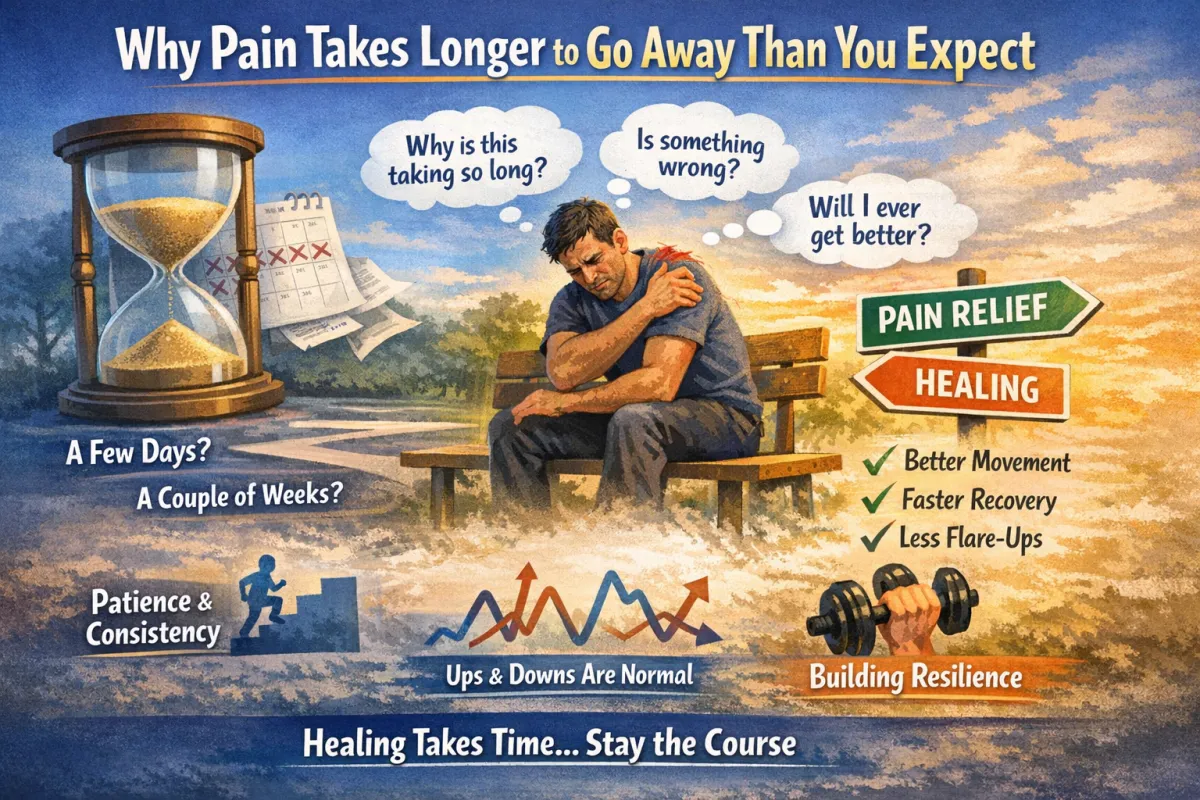
A few days.
Maybe a couple of weeks.
And when it doesn’t, frustration sets in.
This is one of the most common reasons people feel discouraged, lose confidence, or start questioning whether their body is “broken” or whether treatment is even working.
But pain lasting longer than expected usually doesn’t mean something is wrong.
More often, it means the body is still adapting.
Why the Timeline Is Often Longer Than Expected
When pain first shows up, it’s natural to want it gone as soon as possible.
But the body doesn’t heal on a fixed schedule.
Muscles, joints, tendons, and the nervous system all adapt at different speeds — especially if pain has been present for weeks, months, or longer.
Even when tissues are healing, the nervous system may still be sensitive to movement, load, or stress. That sensitivity can keep pain around longer than people expect, even when damage is no longer occurring.
Healing isn’t just about calming symptoms.
It’s about rebuilding tolerance.
Pain Relief vs. Healing
Pain relief and healing are not the same thing.
Pain relief focuses on making symptoms feel better in the moment.
Healing focuses on helping the body tolerate normal movement and activity again.
It’s possible for pain to decrease quickly — and it’s also possible for healing to continue even when some pain remains.
This is why people can feel:
“Better, but not normal yet”
Improved one week, sore the next
Confused about whether progress is actually happening
In many cases, it is.
Many people dealing with low back pain or shoulder pain experience this difference between short-term relief and long-term recovery.
What Real Progress Often Looks Like
Progress doesn’t always show up as pain disappearing completely.
More often, it shows up as:
Better movement quality
Less frequent flare-ups
Faster recovery after activity
These changes indicate that the body is becoming more resilient, even if symptoms still fluctuate.
Healing is often gradual and uneven — not because it’s failing, but because the body is learning how to tolerate more.
Why Frustration Is So Common
When pain lasts longer than expected, many people start to think:
“Why am I still feeling this?”
“Shouldn’t this be gone by now?”
“Is something being missed?”
That frustration is completely understandable.
Unfortunately, frustration often leads to:
Doing too much too quickly
Or avoiding movement altogether
Losing consistency
Giving up too early
None of those responses help the body adapt.
Understanding the process helps people stay engaged instead of discouraged.
Healing Is About Adaptation, Not Perfection
The goal of recovery isn’t to eliminate every sensation immediately.
The goal is to help the body:
Tolerate normal movement
Handle daily activity without fear
Recover more quickly when symptoms do flare
When this happens, confidence improves.
And when confidence improves, outcomes improve.
Final Thought
If pain is taking longer to go away than you expected, it doesn’t automatically mean something is wrong.
In many cases, it means your body is still adapting.
Understanding that timeline — and what progress actually looks like — helps people stay patient, consistent, and moving forward instead of getting stuck in frustration.
Learn more about common causes of pain:
Low Back Pain | Shoulder Pain | Knee Pain | Neck Pain


