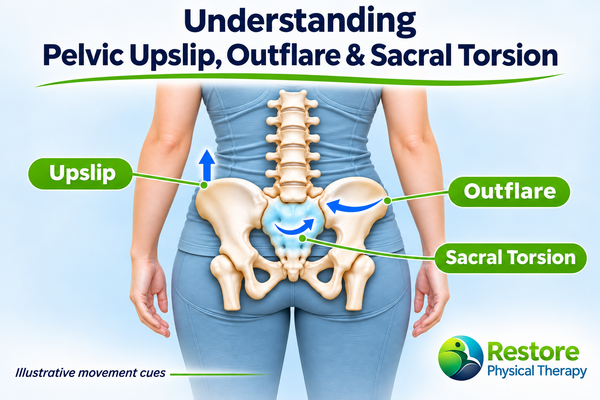
Pelvic Upslip, Outflare & Sacral Torsion Explained
Does your back or SI joint pain keep returning, even after treatment? You may have tried stretching, exercises, or hands-on care and still have trouble getting out of a chair, walking, or turning in bed.
At Restore Physical Therapy in Rochester Hills, we look for pelvic and SI joint patterns that may have been missed during previous care — including pelvic upslip, outflare, and sacral torsion.
At Restore PT, we regularly encounter these findings in patients who have back or SI pain. Here is what the terms mean and how we use treatment and re-testing to guide care.
What do these terms mean?
Your pelvis includes two hip bones and the sacrum, the triangular bone at the bottom of your spine. The sacroiliac, or SI, joints connect the sacrum to the hip bones. These joints normally allow only small amounts of movement.
Pelvic upslip: A pattern in which one side of the pelvis appears to sit higher relative to the sacrum.
Outflare: A pattern in which one or both pelvic bones appear turned outward relative to the sacrum. When both sides are involved, this is called bilateral outflare.
Sacral torsion: A term describing a twisting or rotational pattern of the sacrum. It does not mean the bone is damaged.
These are labels we use during your exam. We weigh them together with your symptoms, how you move, and your muscle strength. Back, hip, and nerve problems can cause similar symptoms, so we assess other possible explanations too.
First, we assess what is happening
We ask about your symptoms, previous treatment, and the activities you want to do more comfortably. Then we check your pelvic and lower-back movement, hip motion, and the muscles that support your pelvis.
We also check an activity that brings on your symptoms. That could be standing from a chair, walking, or bending. We note your starting point so we can compare the same tests and activity after treatment.
Then, we treat the findings
We choose treatment based on what the exam shows — for example, gentle hands-on work or a specific movement aimed at the patterns we found. The treatment is chosen for you and explained before we begin.
We recheck the findings and your pain
After treatment, we repeat the relevant examination checks to see whether the pelvic findings have improved. We also ask you to repeat the same movement or activity that originally caused pain.
Has the movement become easier? Has the pain decreased? Have the examination findings changed?
When the re-test shows the patterns have improved and your pain has eased, it tells us those patterns were likely part of the problem. Your response helps guide what we do next.
This is our TEST → CORRECT → RE-TEST approach.
We build strength to help maintain progress
Feeling better after treatment is the starting point. We then work on strengthening the muscles that support your pelvis and improving how you control movement.
Your exercises and home program are chosen from your needs and progressed as you improve. The goal is to help you keep making progress with walking, stairs, getting out of a chair, and the activities that matter to you.
See if the $49 SI Discovery Visit is right for you
If back or SI joint pain keeps coming back, our 30-minute, one-on-one Discovery Visit gives us a chance to assess how you move and, when appropriate, try treatment and re-test your response.
The visit is $49, paid out of pocket. If you’re not a candidate, we’ll refund your $49. Once you qualify and complete payment, our office will contact you to schedule.


